A microcement installation in a home usually takes 3 to 5 working days, and each individual coat is touch-dry within a few hours. It is not a continuous job: microcement is built up in layers, and every layer needs to dry before the next one goes on, so the timescale is counted in days rather than hours. The good news is that, because it is a renovation with no building work, in most cases you can carry on living at home while it happens.
Application
Microcement Drying Times: Can You Live in the House During Installation?
How long microcement takes to dry, how long the job takes, and whether you can keep living at home during installation. An honest, applicator's guide to drying and curing times, room by room.
- Esteban Godoy Méndez
- 11 min read
- Category
- Application
- Reading
- 11 min
- Coverage
- Costa del Sol
Section 01
How long does microcement take to dry and install?
This is one of the questions that stops people from committing: *"will I have to move out?"*. After years applying microcement across Málaga and the Costa del Sol, here is an honest breakdown of how long it really takes, how long each coat needs to dry, when you can walk on and use each room, and why rushing the cure is the mistake that costs the most.
Section 02
Why is microcement counted in days, not hours?
Microcement is not a single coat of paint: it is a multi-layer system built up one layer at a time. Each layer has a job —grip, body, colour, protection— and needs to dry enough before it can take the next. Push that rhythm and the result suffers: you get staining, poor adhesion, or a sealer that never hardens properly.
A typical project runs through these stages, spread across several visits:
- Substrate preparation: cleaning, degreasing, repair and, where needed, filling tile grout lines. This usually takes a day.
- Bonding primer: the base that stops the microcement from lifting later. It has to dry before work continues.
- Base and body coats with reinforcing fibreglass mesh at critical points: applied and sanded, with drying between each.
- Finish coats: the ones that set the colour and texture. These also need drying and fine sanding.
- Final sealing with one or more coats of sealer, with its own drying time between coats.
Across all these stages you stack up several short drying windows, and it is those windows that explain why a small bathroom is not finished in a single day even though the surface area is tiny.
Indicative timescales by type of project
Every home is different, but these references give you a realistic idea of how long the work takes:
| Project | Indicative working time | Note |
|---|---|---|
| One bathroom or shower / wet room | 3 to 5 days | Small in metres, but demanding on waterproofing and sealing |
| Floor in a single room | 3 to 4 days | Depends on the state of the substrate and the finish |
| Floor across the whole home | 5 to 8 days | Done room by room to keep the home liveable |
| Kitchen (floor, walls or splashback) | 4 to 6 days | More labour around splashbacks and corners |
One bathroom or shower / wet room
- Indicative working time
- 3 to 5 days
- Note
- Small in metres, but demanding on waterproofing and sealing
Floor in a single room
- Indicative working time
- 3 to 4 days
- Note
- Depends on the state of the substrate and the finish
Floor across the whole home
- Indicative working time
- 5 to 8 days
- Note
- Done room by room to keep the home liveable
Kitchen (floor, walls or splashback)
- Indicative working time
- 4 to 6 days
- Note
- More labour around splashbacks and corners
These are active working timescales. On top of them sits the curing time of the sealer, which does not stop you living at home but does decide when you can use the area heavily. For an estimate matched to your surface area and the real condition of the substrate, the best move is to ask for an assessment; you can see the detail on our microcement pricing page.
Section 03
How long does each coat of microcement take to dry?
Each coat of microcement is usually touch-dry within 4 to 8 hours, depending on the product and, above all, the conditions in the room. There is no universal number: what an applicator controls is that each layer is at the right point before moving on, not that a fixed count of hours has passed.
It helps to separate two ideas that are often confused:
- Drying: the coat loses its surface moisture and is ready for the next layer or for sanding. This is relatively quick, from a few hours to most of a day.
- Curing: the sealer completes its chemical hardening and reaches its full hardness, resistance and waterproofing. This is slower, from several days to a couple of weeks.
A surface being dry to the touch does not mean it is cured. That difference is the key to everything that follows: you can walk on the floor before the sealer has cured, but you cannot expose it to standing water or heavy traffic until curing is complete.
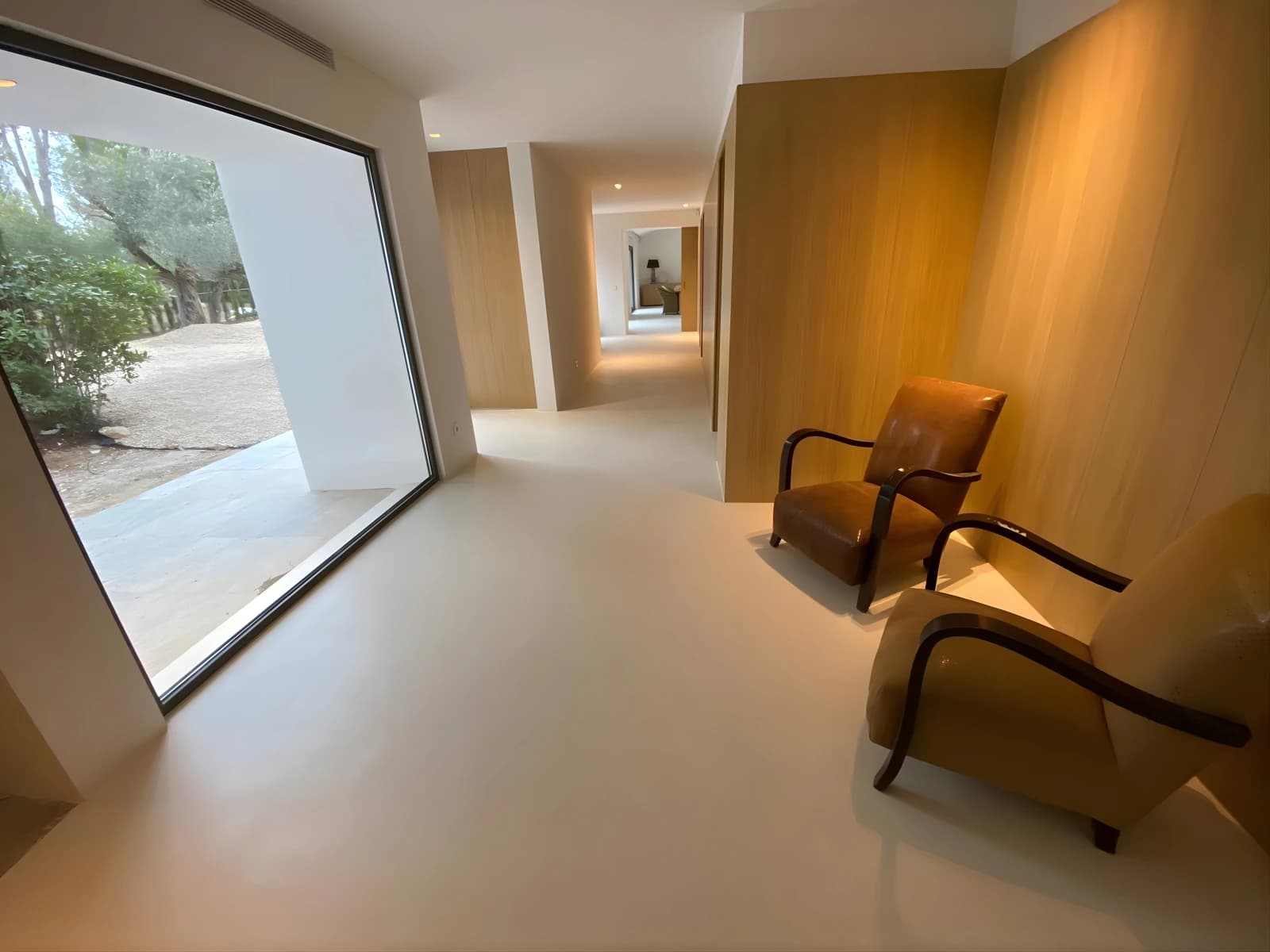
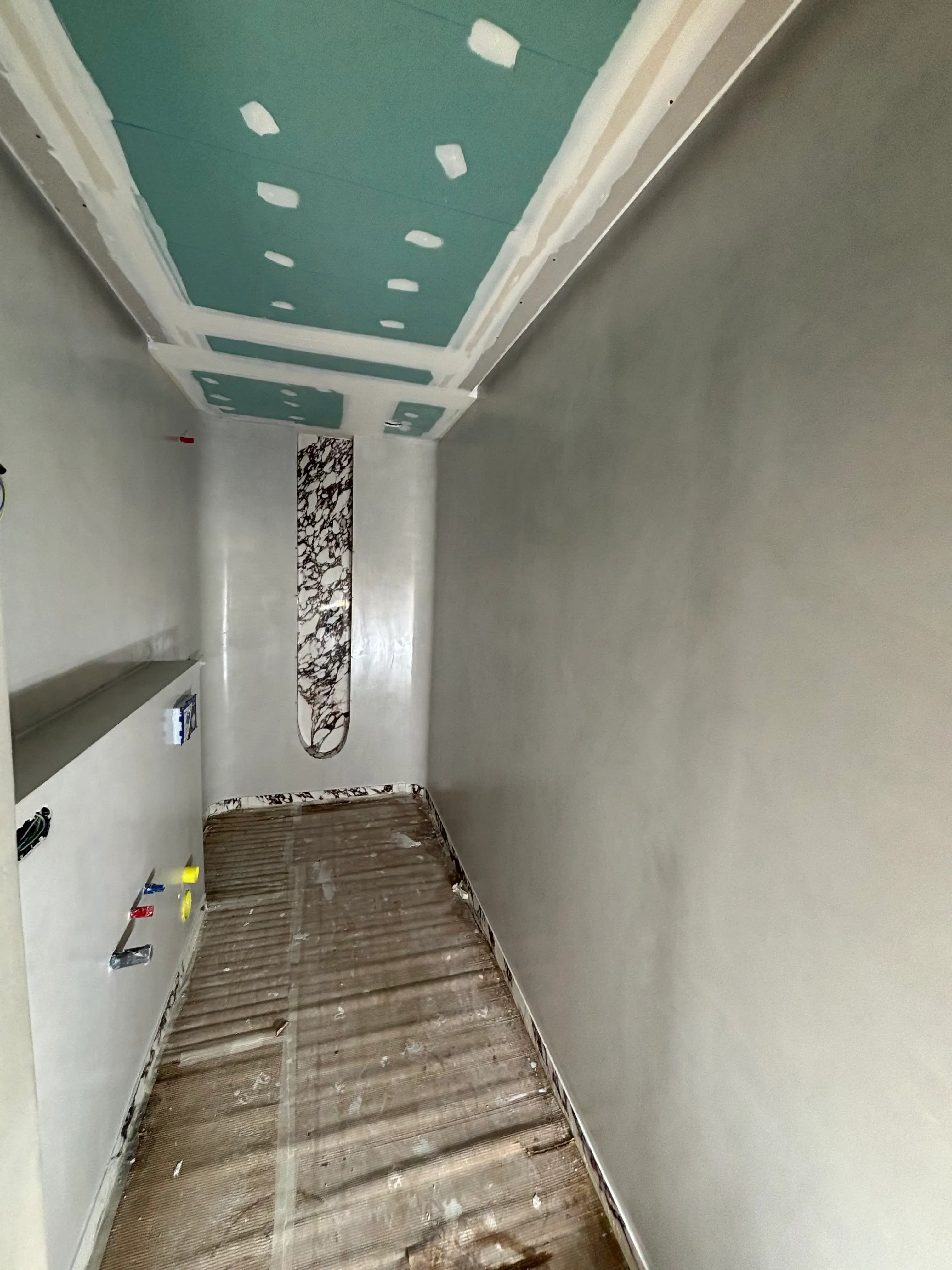
Microcement on site
Section 04
When can you walk on a microcement floor?
You can walk on a microcement floor in clean, soft-soled shoes about 24 to 48 hours after the final sealing, always carefully and without dragging furniture or objects across it. It is the first milestone people wait for, but it is not the only one that matters.
The real progression of use tends to run like this:
- First 24 to 48 hours after sealing: light, occasional steps in clean shoes. No furniture, no loads.
- A few days later: furniture can go back, ideally with felt pads under the legs, and you can live normally as long as nothing is dragged.
- Once the sealer has fully cured (as a guide, one to two weeks depending on product and temperature): washing with water, heavy foot traffic and full use with no restrictions.
A continuous, seamless surface is one of the great advantages of microcement floors, but that finish only delivers its best if you respect these first days. Early patience translates into years of durability.
Section 05
Can you live in the house during microcement installation?
Yes, in most cases you can keep living at home during a microcement installation. That is precisely one of its biggest advantages over a conventional renovation: nothing is chiselled out, there is no demolition, no rubble is generated and there is almost no dust. The home does not turn into a building site, and there is no skip hire to organise.
The usual way of working so it fits around daily life is room by room: one room or bathroom is treated while the rest stays in use, and the treated surface is kept clear until it has dried enough to step on. If there is only one bathroom, the job is planned so the time without it is the bare minimum.
What are the real inconveniences, being honest?
- The smell of the sealer, especially polyurethane sealers, during application and the hours after. It ventilates well and clears quickly; airing the room is enough.
- Not stepping on the freshly applied area until it dries, which means organising how you move through the home for a few days.
- Some temporary disruption while the project runs, far less than a renovation with building work.
For families with children, pets or long days out of the house, it is worth talking it through with the applicator and planning the rooms in advance. For a specific bathroom, where and when you can use it is something we cover in our guide to microcement bathrooms.
When can you use the shower and wet the area?
Here you have to be strict: direct water is the last thing that should touch microcement. Even though the surface is walkable within a few days, a shower or any area of standing water should only be used once the sealer has fully cured, which as a guide takes around 7 to 10 days after the final coat.
The reason is technical: microcement itself is porous, and what makes it waterproof is the sealer. If you wet the area before that sealer has hardened completely, you put the waterproofing and the adhesion at risk exactly where they matter most. That is why, in a wet room, waiting for the sealer to cure is non-negotiable.
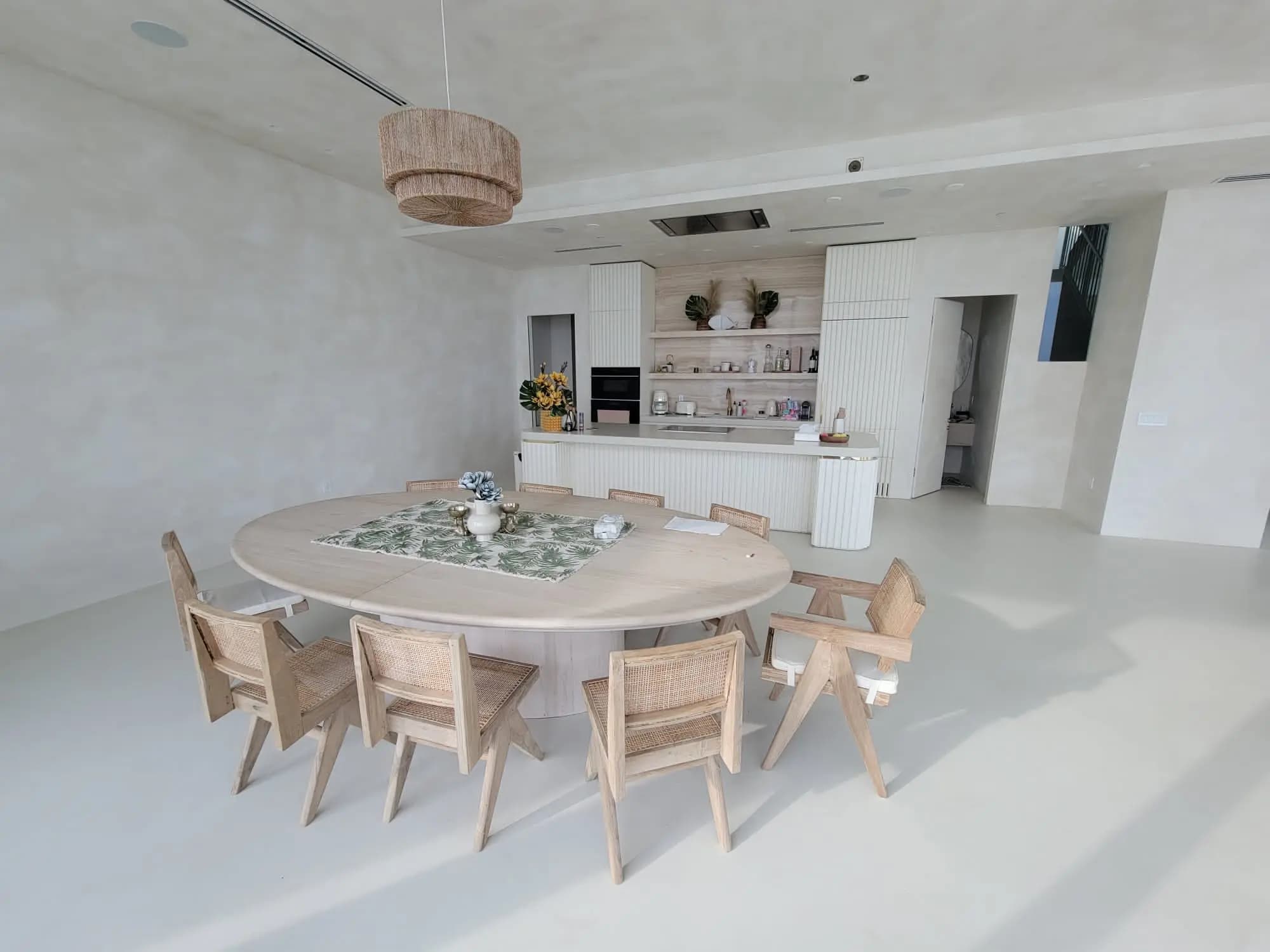
Microcement on site
Section 06
What makes microcement dry faster or slower?
The timescale is not fixed because it depends on real factors that an applicator judges case by case. The main ones are:
- Temperature and humidity: with dry warmth and good ventilation each coat dries sooner; with cold or high humidity, everything slows down. In the warm Costa del Sol climate, drying is usually brisk, though a very humid easterly day will also slow things.
- Ventilation in the room: moving air speeds up drying noticeably.
- The square metres and number of rooms: more surface means more days, although working room by room does not multiply the time in a straight line.
- The condition of the substrate: if it needs repair, levelling or waterproofing, that adds preparation days.
- The chosen finish: a metallic or heavily textured effect needs more labour and more sanding than a smooth one.
- The sealer: each product has its own drying and curing curve.
This is why a serious professional will not give you an exact hour: they give a realistic window and adjust the pace to the conditions on the day. Forcing the calendar beyond what the drying allows is the most common cause of later problems.
Section 07
Is microcement installation messy — dust, smell, skip hire?
No, a microcement installation is a notably clean job compared with retiling or any renovation that involves demolition. Because microcement goes over the existing surface —tiles, ceramic, plaster or concrete— nothing is ripped out. There is no chiselling, no rubble bags piling up on the landing and no skip hire blocking the drive. The little dust there is comes from light sanding between coats and is straightforward to manage.
The honest exception is the smell of the sealer. Polyurethane sealers carry a noticeable odour during application and for a few hours afterwards, so the room needs airing. It is temporary and clears with ventilation, and it is the single trade-off most homeowners happily accept in exchange for a renovation that leaves the home liveable throughout.
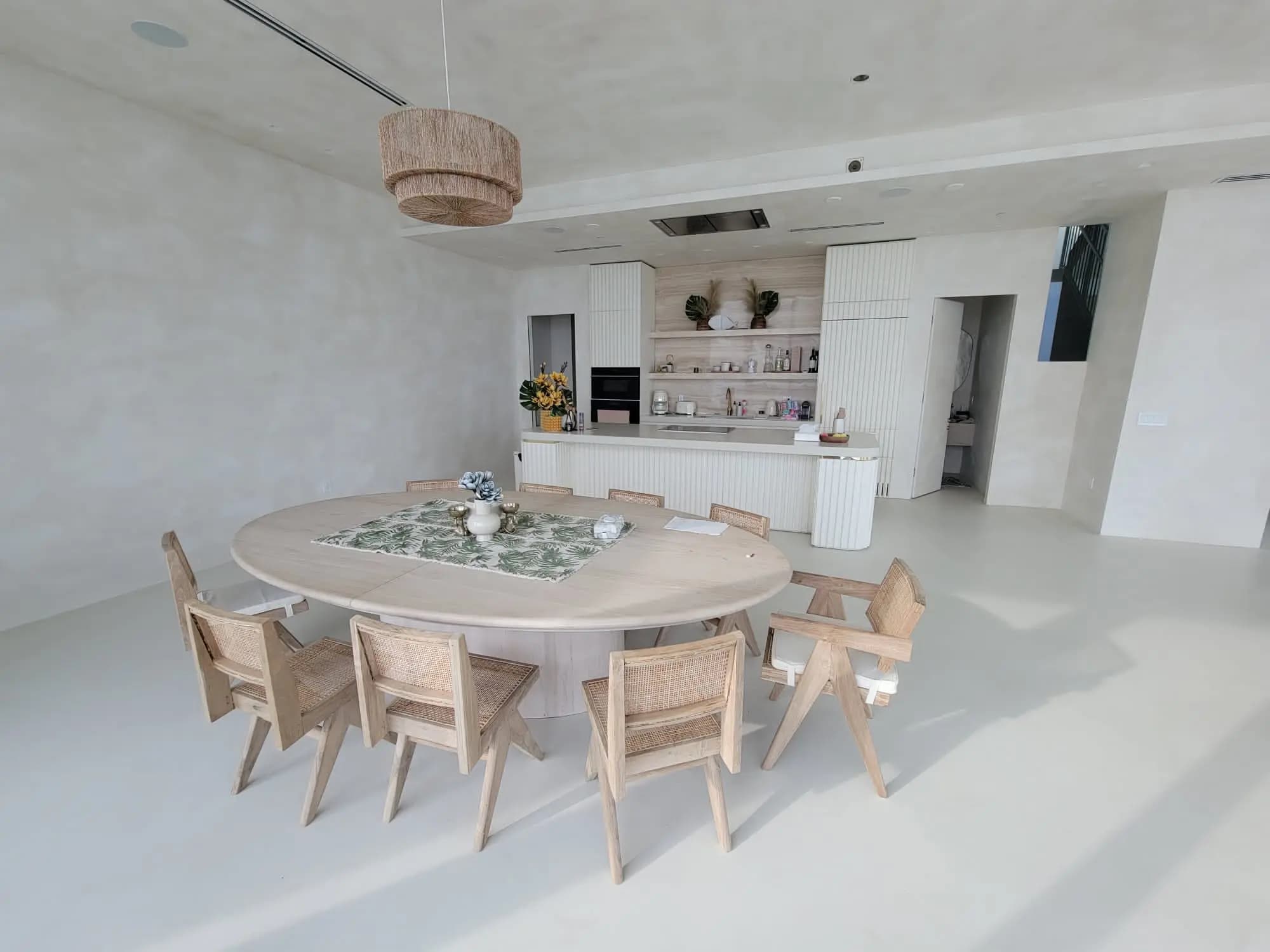
Microcement on site
Section 08
Why shouldn't you rush the cure of the sealer?
Because the sealer is the protective layer that defines the durability of the whole job, and its hardening is a chemical process that needs its time. Expose it to water, cleaning products or heavy traffic before it has cured and you can cause marks, loss of sheen, staining or a drop in waterproofing that does not show on day one but does with use.
The difference between a microcement that lasts for years and one that gives trouble early usually comes down, on top of the application itself, to respecting these final windows. It is the part you cannot see in a photo, but it is the part that holds the result together over time.
If you are weighing up a microcement project in Málaga or on the Costa del Sol and want a concrete timescale for your case, ask us for a no-obligation assessment: we plan the rooms so living alongside the work is as comfortable as possible.
Section 09
Frequently asked questions about microcement drying times
How long does microcement take to dry? Each coat is touch-dry in a few hours, typically 4 to 8, but full curing of the sealer takes longer. A whole project usually spans 3 to 5 working days because of the layers and their drying times. Drying speed depends mainly on temperature, humidity and ventilation. Touch-dry is not the same as fully cured.
How long does it take to install microcement? A typical installation takes 3 to 5 working days, spread across several visits. It is not continuous work: each layer has to dry before the next goes on. The surface area, the condition of the substrate, the finish and the weather all push that timescale up or down.
Can you live in the house during microcement installation? Yes, in most cases. It is a renovation with no building work: nothing is chiselled out, there is no rubble and almost no dust. The job is done room by room, and the treated area is kept clear until it dries. The main inconvenience is the smell of the sealer, which ventilates within a few hours.
How long before you can walk on a microcement floor? You can walk on it in clean, soft-soled shoes about 24 to 48 hours after the final sealing, carefully and dragging nothing. For normal use and replacing furniture, wait a few more days. For washing with water and heavy traffic, wait until the sealer has fully cured, which can take one to two weeks.
How long until you can use a microcement shower or wet room? Only once the sealer has fully cured, as a guide around 7 to 10 days after the final coat. The surface is walkable sooner, but standing water and direct spray demand complete curing of the polyurethane sealer to keep the area watertight and avoid staining or adhesion problems.
What affects microcement drying and curing times? Above all, temperature, humidity and ventilation. Dry warmth and good airflow speed each coat up; cold or high humidity slows it down. The square metres, the number of coats, the chosen finish and the sealer also matter, which is why a professional gives a realistic window rather than a fixed hour.
Frequently asked questions
Common questions
How long does microcement take to dry?
Each microcement coat is touch-dry in a few hours, typically 4 to 8 hours, but full curing of the sealer takes longer. A whole project usually spans 3 to 5 working days because of the layers and their drying times. Drying speed depends mainly on temperature, humidity and ventilation. Touch-dry is not the same as fully cured: the surface can be ready for the next coat long before the sealer has reached its final hardness and waterproofing.
How long does it take to install microcement?
A typical microcement installation takes 3 to 5 working days, spread across several visits. It is not continuous work: each layer has to dry before the next one goes on, so the job is measured in days, not hours. A single bathroom, a single floor, the surface area, the condition of the substrate, the finish and the weather all push that timescale up or down. The applicator builds the schedule around the real drying conditions, not a fixed clock.
Can you live in the house during microcement installation?
Yes, in most cases you can keep living at home during a microcement installation. It is a renovation with no building work: nothing is chiselled out, there is no rubble and almost no dust. The job is normally done room by room, so the rest of the home stays in use while one area sets. The main inconvenience is the smell of the sealer, which ventilates within a few hours. With a single bathroom, the work is planned so you lose it for the shortest possible time.
How long before you can walk on a microcement floor?
You can walk on a microcement floor in clean, soft-soled shoes about 24 to 48 hours after the final sealing, treading carefully and dragging nothing. For normal use and replacing furniture, wait a few more days. For washing with water and heavy foot traffic, wait until the sealer has fully cured, which can take one to two weeks depending on the product and the temperature. Patience in those first days is what buys you years of durability.
How long until you can use a microcement shower or wet room?
Use a microcement shower or wet room only once the sealer has fully cured, which usually takes around 7 to 10 days after the final coat. The surface is walkable sooner, but standing water and direct spray demand the complete curing of the polyurethane sealer to guarantee it stays watertight. Wetting the area too early risks staining and adhesion problems exactly where waterproofing matters most. Respecting that window is non-negotiable in a wet room.
What affects microcement drying and curing times?
Microcement drying and curing times depend above all on temperature, humidity and ventilation. Dry warmth and good airflow speed each coat up; cold or high humidity slows everything down. The square metres, the number of coats, the chosen finish and the sealer also matter. That is why a professional will not promise an exact hour: they give a realistic window and adjust the pace to the conditions on the day. On the Costa del Sol the warm, dry climate usually keeps drying brisk.

Written by
Esteban Godoy Méndez
Microcement applicator and founder of GM Microcemento
Esteban Godoy is a professional microcement applicator and the founder of GM Microcemento. Since 2020 he has delivered continuous-coating projects in homes and commercial spaces across Málaga and the Costa del Sol.
Meet GM MicrocementoKeep reading
Related articles
 Guides
Does Microcement Crack or Scratch? An Honest Guide to Real Durability
Does microcement crack or scratch? An honest look at its real durability, why problems happen, how long it lasts and how cracks and scratches are repaired.
Esteban Godoy MéndezRead article
 Guides
Microcement Outdoors: Terraces, Facades and Pools on the Costa del Sol
Is microcement good for outdoors? An applicator's honest guide to using it on terraces, facades and pools on the Costa del Sol, with real answers on sun, UV, chlorine and slip resistance.
Esteban Godoy MéndezRead article

Online estimator
Your quote in 4 simple steps
Estimate your microcement online in under 5 minutes. We review it by hand within 48 hours and send you a precise quote, with no obligation.
Fast
4 simple steps, done in 5 minutes.
Reviewed in 48h
A specialist checks it by hand — not an automatic number.
Precise
A quote tailored to your square metres and your finish.
Take the next step
Ready to take the step with microcement?
If this guide has cleared up your doubts, let's take the next step: work out the cost or ask us for a no-obligation quote in Málaga and across the Costa del Sol.