Applied correctly, microcement neither cracks on its own nor scratches easily. It is a flexible, resin-based coating, not brittle concrete, and once sealed its surface stands up to daily foot traffic. The honest caveat: almost every crack or scratch we are called out to fix traces back to a fault in the installation or the substrate — not to the material.
Guides
Does Microcement Crack or Scratch? An Honest Guide to Real Durability
Does microcement crack or scratch? An honest look at its real durability, why problems happen, how long it lasts and how cracks and scratches are repaired.
- Esteban Godoy Méndez
- 10 min read
- Category
- Guides
- Reading
- 10 min
- Coverage
- Costa del Sol

Section 01
Does microcement crack or scratch over time?
I am Esteban Godoy, a microcement applicator and the founder of GM Microcemento. Since 2020 I have laid, sealed and — yes — occasionally repaired continuous coatings across Málaga and the Costa del Sol. This is the guide I wish more people read before deciding: the real durability of microcement, the problems that genuinely occur, why they happen, and what to do about them. No sales gloss.
Section 02
Does microcement crack over time?
Microcement does not crack of its own accord. Cracks appear when something underneath it moves more than the coating can absorb. Understanding that difference is the key to the whole question.
Microcement is only 2 to 3 mm thick and bonds tightly to whatever it is applied over. It has no structural strength of its own — it borrows the stability of the substrate beneath it. The resins in the mix give it enough flexibility to follow tiny, everyday movements (thermal expansion, slight deflection in a floor) without breaking. What it cannot do is bridge a substrate that is actively cracking, lifting or shifting. If the base moves, the coating telegraphs that movement to the surface.
So when you see a crack in microcement, the right question is rarely "is the material faulty?" and almost always "what is the base doing underneath it?"
Does microcement crack with underfloor heating?
No, not if the floor is prepared and commissioned correctly. The risk with underfloor heating is thermal movement in the screed, so the protocol matters: the screed must be fully cured and dry, the heating switched off before application, and brought back up gradually afterwards. Done properly, microcement is an excellent partner for underfloor heating because its thin, dense layer conducts heat well.
Section 03
Why does microcement crack — and how do you avoid it?
Microcement cracks for a handful of well-understood reasons, and every one of them is preventable. In my experience these are the real culprits, roughly in order of how often I see them:
- An unstable or moving substrate. Loose tiles, a hollow screed, fresh plaster still drying, or a floor that flexes. The coating cannot fix a base problem; it reveals it.
- Skipping the reinforcing mesh. A fibreglass mesh is embedded in the base coats to spread stress across the surface. Leave it out to save time and you remove the layer that prevents hairline cracking.
- No expansion joints respected. Existing structural and perimeter joints in a building must be carried through the microcement. Coating straight over them is asking for a crack along that line.
- Layers applied too thick, or curing rushed. Microcement is built up in thin coats with drying time between each. Pile it on thick or seal it before it has cured and you trap stress and moisture inside.
- Damp or moisture in the substrate. Rising damp or an unsealed slab pushes moisture up into the coating, breaking the bond over time.
Notice the pattern: none of these is a flaw in microcement. They are workmanship and preparation faults. This is precisely why microcement is not a DIY product, however many kits are sold as if it were. The skill is in the substrate diagnosis and the system, not in spreading the paste. A good applicator spends most of the job on what you will never see.
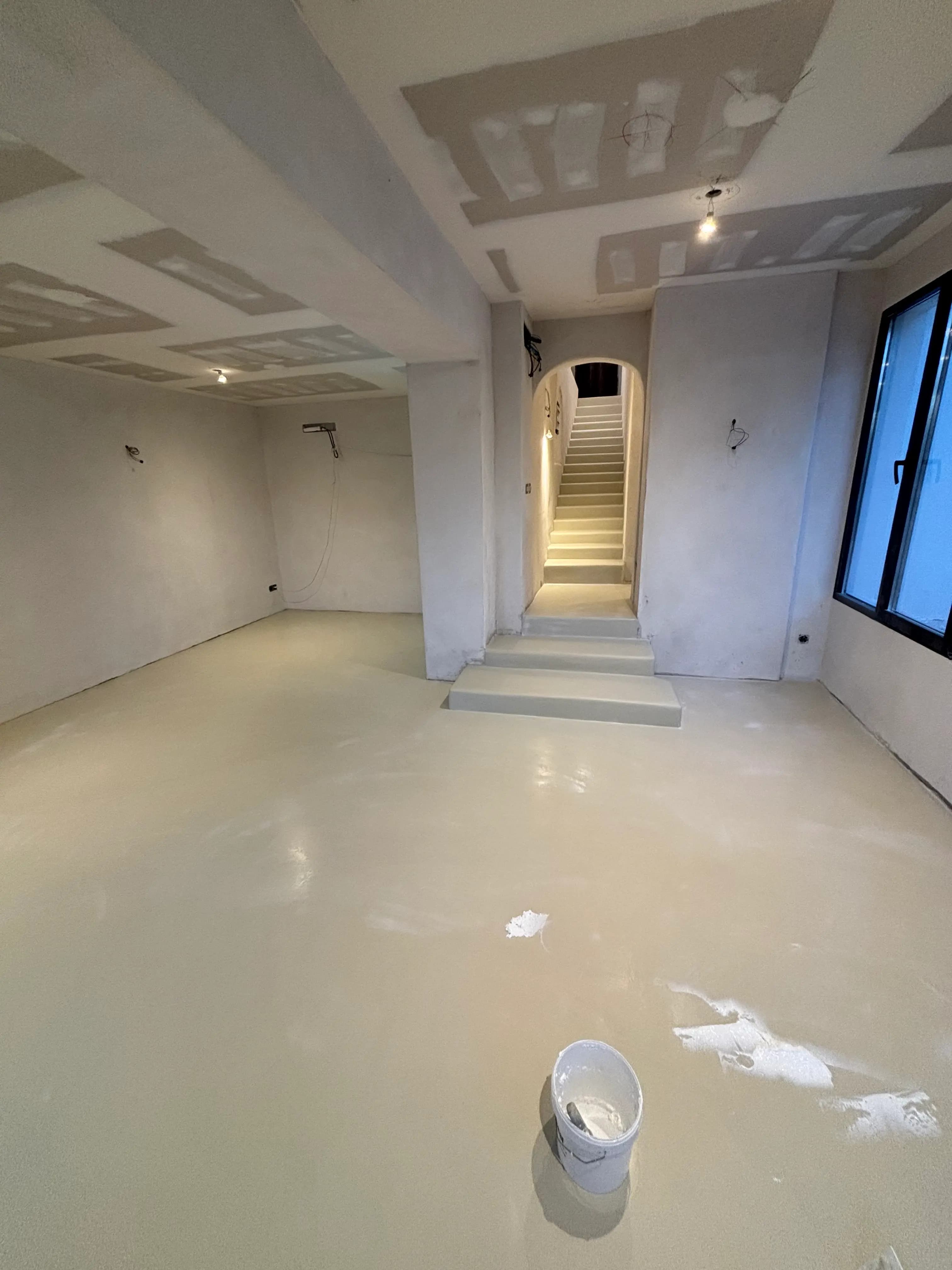
Microcement on site

Section 04
Does microcement scratch easily?
No. A correctly sealed microcement surface resists everyday scratching well, because its hardness lives in the sealer, not in the cement underneath. The cement gives you the look; the polyurethane or acrylic top sealer gives you the wear resistance. Get the sealer right and you have a hard, closed surface.
That said, no floor on earth is scratch-proof, and honesty matters here. Microcement can pick up fine marks the same way wood, vinyl or even some stone can: dragging a heavy chair or sofa across it, grit trodden in from outside acting like sandpaper, or a dropped sharp object. The good news is twofold. First, prevention is simple and cheap. Second, light scratches are far less visible on a matte, handcrafted microcement than on a glossy synthetic floor, and they are easy to disguise when you renew the sealer.
A few habits keep a microcement floor looking new:
- Fit felt pads under chair, table and sofa legs.
- Place doormats at entrances to stop grit being walked in.
- Lift furniture rather than dragging it.
- Sweep or vacuum grit regularly, especially in hallways.
Section 05
How long does microcement last?
A well-applied and well-maintained microcement floor lasts 15 to 20 years or more while keeping its appearance. Crucially, the cementitious layer itself does not "wear out" — it is mineral and extremely stable. What ages is the protective sealer on top, which slowly loses its sheen and protection in busy areas.
This is the single most reassuring fact about microcement durability, and the one most often missed: because the wearing part is the sealer, the floor is essentially renewable. When the sealer tires, you clean the surface and apply a fresh top sealer — no demolition, no replacement — and the floor is protected again for years. A microcement floor is not a finite product counting down to replacement; it is a surface you periodically re-protect. That is why, looked after, it can comfortably outlast the fashions of the room it sits in.
Microcement on site

Section 06
What are the most common microcement problems?
The most common microcement problems are hairline cracks, surface staining and patches lifting or delaminating. Here is the honest part: in the overwhelming majority of cases, these are installation problems wearing a microcement costume — not failures of the material.
| Problem | What it looks like | The usual real cause |
|---|---|---|
| Hairline cracks | Fine lines, often following a joint or stress point | Unstable substrate, no mesh, ignored expansion joints, layers too thick |
| Scratches | Light surface marks, more visible in raking light | Dragged furniture, grit underfoot, weak or worn sealer |
| Staining / water marks | Darker patches, rings from spills | Sealer not closed properly, spills left too long, harsh products |
| Lifting / delamination | A patch detaches or sounds hollow | Poor adhesion: dirty base, wrong primer, damp substrate |
| Colour or tone variation | Slight unevenness across the surface | Its handcrafted nature — usually a feature, occasionally poor technique |
Hairline cracks
- What it looks like
- Fine lines, often following a joint or stress point
- The usual real cause
- Unstable substrate, no mesh, ignored expansion joints, layers too thick
Scratches
- What it looks like
- Light surface marks, more visible in raking light
- The usual real cause
- Dragged furniture, grit underfoot, weak or worn sealer
Staining / water marks
- What it looks like
- Darker patches, rings from spills
- The usual real cause
- Sealer not closed properly, spills left too long, harsh products
Lifting / delamination
- What it looks like
- A patch detaches or sounds hollow
- The usual real cause
- Poor adhesion: dirty base, wrong primer, damp substrate
Colour or tone variation
- What it looks like
- Slight unevenness across the surface
- The usual real cause
- Its handcrafted nature — usually a feature, occasionally poor technique
The thread running through every row is the same: substrate preparation, the system and the seal. Choose your applicator on those three things, not on the lowest quote, and most of this table never becomes your problem. A cheap installation is the most expensive kind, because the only real fix for a failed base is to start again.
Section 07
Can cracks and scratches in microcement be repaired?
Yes — and this is one of microcement's quiet advantages over tiles or stone. Because it is applied by hand in layers, it can be repaired in place, without ripping up the whole floor.
For a crack, the line is opened up slightly, the underlying cause is addressed (reinforcement added if the substrate needs it), then it is refilled, blended into the surrounding texture and resealed. For scratches and dull, worn areas, the most common fix is simply to clean the surface and apply a fresh coat of sealer, which buffs out light marks and restores the protection and finish in one go. Because the repair is handcrafted to match, it integrates far more naturally than a swapped tile ever could — there is no visible "patch" line if it is done well.
If you already have microcement that has cracked, scratched or lost its shine, you do not necessarily need a whole new floor. Talk to a professional applicator first — a localised repair and reseal is often all it takes.
Microcement on site

Section 08
Is microcement durable enough for high-traffic floors?
Yes. Microcement is genuinely well suited to high-traffic areas — busy hallways, open-plan kitchens, hospitality floors and shops — as long as the system is specified for that use from the outset. The difference between a domestic finish and a hard-wearing commercial one is mostly in the sealer and the number of coats, not the cement.
For heavy use we specify a tougher polyurethane top sealer, build the protection up in more coats, and choose a finish that hides everyday traffic. Get those decisions right at the quoting stage and the floor handles real life: trolleys, heels, pets and footfall. You can see the full range of looks on our microcement floors page, and explore textures and tones in finishes and colours — some finishes simply mask wear better than others, which matters more than people expect in a busy home.
Section 09
The honest verdict on microcement durability
Microcement is a tough, long-lasting, repairable surface — when it is applied properly. It does not crack or scratch because of some flaw in the material; it suffers when the substrate is wrong, the mesh is skipped, the joints are ignored or the seal is poor. Every one of those is a choice made during the job, not a property of the coating.
So the real durability question is not "is microcement reliable?" but "who is applying it, and how?" If you want a continuous floor or wall that genuinely lasts on the Costa del Sol, the most important decision you make is your applicator. We are happy to talk through your specific surface and its condition before you commit — see our pricing for guidance, or get in touch for an honest assessment.
Section 10
Frequently asked questions about microcement durability
Does microcement crack? Applied correctly, microcement does not crack on its own. The resins in the mix give it flexibility to absorb the small movements of the substrate. Cracks almost always come from an unstable base, a skipped reinforcing mesh, missing expansion joints or layers applied too thick — not from the material itself.
Does microcement scratch easily? No, a properly sealed microcement floor resists everyday scratching well. Its surface hardness comes from the sealer, not the cement. Light marks can appear from dragging heavy furniture or grit underfoot, but with felt pads, doormats and a sound sealer, scratching is rare in a domestic home.
How long does microcement last? A well-applied, well-maintained microcement floor lasts 15 to 20 years or more while keeping its look. The cement layer itself does not wear out; what ages is the protective sealer. Renewing the top sealer every few years, depending on traffic, resets its protection and extends the life almost indefinitely.
What are the most common microcement problems? The most common microcement problems are hairline cracks, staining and patches lifting or delaminating. Almost all of them trace back to installation faults — an unstable substrate, no reinforcing mesh, poor sealing or rushed curing — rather than the material. A correct system applied by a professional avoids them.
Can cracks or scratches in microcement be repaired? Yes. Microcement is repairable in place without lifting the whole floor. A localised crack is opened, reinforced, refilled and blended, then the area is resealed. Light scratches are usually buffed out or hidden by renewing the sealer. Because it is handcrafted, repairs integrate far better than with tiles.
Is microcement durable enough for high-traffic floors? Yes, microcement performs well in high-traffic areas such as hallways, kitchens and shops, provided it is correctly applied and sealed for the use. Abrasion and impact resistance come from the right sealer and number of coats. For commercial wear, a tougher polyurethane sealer is specified from the start.
Frequently asked questions
Common questions
Does microcement crack?
Applied correctly, microcement does not crack on its own. The resins in the mix give it flexibility to absorb the small movements of the substrate. Cracks almost always come from an unstable base, a skipped reinforcing mesh, missing expansion joints or layers applied too thick — not from the material itself.
Does microcement scratch easily?
No, a properly sealed microcement floor resists everyday scratching well. Its surface hardness comes from the sealer, not the cement. Light marks can appear from dragging heavy furniture or grit underfoot, but with felt pads, doormats and a sound sealer, scratching is rare in a domestic home.
How long does microcement last?
A well-applied, well-maintained microcement floor lasts 15 to 20 years or more while keeping its look. The cement layer itself does not wear out; what ages is the protective sealer. Renewing the top sealer every few years, depending on traffic, resets its protection and extends the life almost indefinitely.
What are the most common microcement problems?
The most common microcement problems are hairline cracks, staining and patches lifting or delaminating. Almost all of them trace back to installation faults — an unstable substrate, no reinforcing mesh, poor sealing or rushed curing — rather than the material. A correct system applied by a professional avoids them.
Can cracks or scratches in microcement be repaired?
Yes. Microcement is repairable in place without lifting the whole floor. A localised crack is opened, reinforced, refilled and blended, then the area is resealed. Light scratches are usually buffed out or hidden by renewing the sealer. Because it is handcrafted, repairs integrate far better than with tiles.
Is microcement durable enough for high-traffic floors?
Yes, microcement performs well in high-traffic areas such as hallways, kitchens and shops, provided it is correctly applied and sealed for the use. Abrasion and impact resistance come from the right sealer and number of coats. For commercial wear, a tougher polyurethane sealer is specified from the start.

Written by
Esteban Godoy Méndez
Microcement applicator and founder of GM Microcemento
Esteban Godoy is a professional microcement applicator and the founder of GM Microcemento. Since 2020 he has delivered continuous-coating projects in homes and commercial spaces across Málaga and the Costa del Sol.
Meet GM MicrocementoKeep reading
Related articles
 Guides
Microcement Outdoors: Terraces, Facades and Pools on the Costa del Sol
Is microcement good for outdoors? An applicator's honest guide to using it on terraces, facades and pools on the Costa del Sol, with real answers on sun, UV, chlorine and slip resistance.
Esteban Godoy MéndezRead article
 Application
Microcement Over Tiles: Renovate a Bathroom, Kitchen or Floor Without Removing Them
Yes, you can apply microcement over tiles without taking them off. Here is how the ceramic is prepared, which rooms it suits best, and when it is wiser to strip out instead.
Esteban Godoy MéndezRead article

Online estimator
Your quote in 4 simple steps
Estimate your microcement online in under 5 minutes. We review it by hand within 48 hours and send you a precise quote, with no obligation.
Fast
4 simple steps, done in 5 minutes.
Reviewed in 48h
A specialist checks it by hand — not an automatic number.
Precise
A quote tailored to your square metres and your finish.
Take the next step
Ready to take the step with microcement?
If this guide has cleared up your doubts, let's take the next step: work out the cost or ask us for a no-obligation quote in Málaga and across the Costa del Sol.